

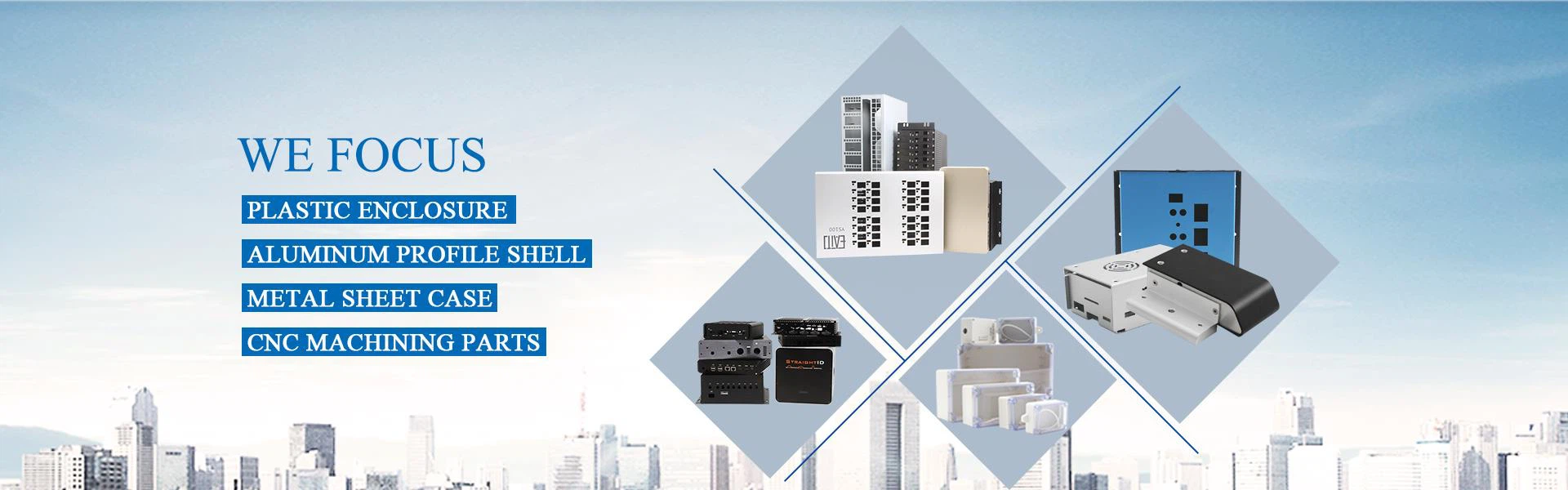
A 19 Inch Case is a standardized frame or enclosure for mounting multiple equipment modules. Each module has a front panel that is 19 inches (482.6 mm) wide, including edges or ears that protrude on each side which allows the module to be fastened to the rack frame with screws.

Why choose us
01
Our Factory
Hongfa Shunda, located in Shenzhen, China, has a 5,000 square meter production facility that includes plastic injection production lines and CNC milling production lines.
02
Production Equipment
The company has several production lines and pieces of equipment, including injection machines, CNC machines, bending machines, laser cutting machines, and punching machines.
03
Production Market
Our products are sold all over the world, especially in North America, Western Europe, Asia, and Oceania.
04
Our Services
The company provides OEM/ODM custom services for electronic enclosures, including design, drawing, hole cutting, surface treatment, printing, and packing.
-
![Junction Box Electrical]() Junction Box ElectricalQuick Details:view more
Junction Box ElectricalQuick Details:view more
1. Product Name: Junction Box Electrical
2. Model No: HF-N-119
3. External size: 48*26*15mm
4. Material: ABS or custom
5. Color: black or... -
![Customized ABS Engineering Plastic Small PCB Electric Control Box - Industrial Grade Wiring Control Box Solution]() Customized ABS Engineering Plastic Small PCB Electric Con...This series is a special protective housing for PCB circuit boards, suitable for electrical connections and control systems of industrial automation, intelligent equipment and precision...view more
Customized ABS Engineering Plastic Small PCB Electric Con...This series is a special protective housing for PCB circuit boards, suitable for electrical connections and control systems of industrial automation, intelligent equipment and precision...view more -
![Manufacturer Customized ABS Material IP54 Small Black Plastic Boxes Enclosure For Electronic Device]() Manufacturer Customized ABS Material IP54 Small Black Pla...Custom ABS Material Small Black PCB Electric Case Plastic Junction Control Box Case Enclosure: Product Type: PCB Electric Case: This indicates that the enclosure is designed to house and...view more
Manufacturer Customized ABS Material IP54 Small Black Pla...Custom ABS Material Small Black PCB Electric Case Plastic Junction Control Box Case Enclosure: Product Type: PCB Electric Case: This indicates that the enclosure is designed to house and...view more -
![Screwless ABS Plastic Electronic Project Box]() Screwless ABS Plastic Electronic Project BoxThis is a screwless plastic enclosure,with size 119*56*30mm,the stock color is black,other colors can be customized as required.Also supply cutting holes,printing logo etc custom service.view more
Screwless ABS Plastic Electronic Project BoxThis is a screwless plastic enclosure,with size 119*56*30mm,the stock color is black,other colors can be customized as required.Also supply cutting holes,printing logo etc custom service.view more -
![Customized Projects Electronic Box New Manufacture Plastic Enclosure]() Customized Projects Electronic Box New Manufacture Plasti...ABS plastic enclosure instrument control box network electronics case shellview more
Customized Projects Electronic Box New Manufacture Plasti...ABS plastic enclosure instrument control box network electronics case shellview more -
![Plastic Junction Box Connection Case Enclosure]() Plastic Junction Box Connection Case EnclosureThis is a Black/White electronic case made of ABS. We are a factory have over 20 years experience in the product of electronic shell. We have excellent quality and competitive prices. Hope we can...view more
Plastic Junction Box Connection Case EnclosureThis is a Black/White electronic case made of ABS. We are a factory have over 20 years experience in the product of electronic shell. We have excellent quality and competitive prices. Hope we can...view more -
![Plastic Case ABS Junction Box Enclosure]() Plastic Case ABS Junction Box EnclosureThis is a Black electronic case made of ABS. We are a factory have over 20 years experience in the product of electronic shell. We have excellent quality and competitive prices. Hope we can...view more
Plastic Case ABS Junction Box EnclosureThis is a Black electronic case made of ABS. We are a factory have over 20 years experience in the product of electronic shell. We have excellent quality and competitive prices. Hope we can...view more -
![Plastic Enclosure Project Housing Case Box]() Plastic Enclosure Project Housing Case BoxThis is a White electronic case made of ABS. We are a factory have over 20 years experience in the product of electronic shell. We have excellent quality and competitive prices. Hope we can...view more
Plastic Enclosure Project Housing Case BoxThis is a White electronic case made of ABS. We are a factory have over 20 years experience in the product of electronic shell. We have excellent quality and competitive prices. Hope we can...view more -
![Hongfa Electronic Waterproof Junction Box Project Case]() Hongfa Electronic Waterproof Junction Box Project CaseElectronics project box plastic case enclosure customview more
Hongfa Electronic Waterproof Junction Box Project CaseElectronics project box plastic case enclosure customview more -
![Electronic ABS Box Enclosure Project Case]() Electronic ABS Box Enclosure Project CaseThis is a White electronic case made of ABS. We are a factory have over 20 years experience in the product of electronic shell. We have excellent quality and competitive prices. Hope we can...view more
Electronic ABS Box Enclosure Project CaseThis is a White electronic case made of ABS. We are a factory have over 20 years experience in the product of electronic shell. We have excellent quality and competitive prices. Hope we can...view more -
![Switch Control Box Enclosure Plastic Junction Box]() Switch Control Box Enclosure Plastic Junction BoxQuick Details:view more
Switch Control Box Enclosure Plastic Junction BoxQuick Details:view more
1. Model No.: HF-N-71
2. Material: ABS or custom
3. External Size: 82*64*25mm
4. Color: Light grey or custom
5. Certificate: CE,ROHS
6. MOQ:... -
![Plastic Boxes Pcb Housing For Electronic Device]() Plastic Boxes Pcb Housing For Electronic DeviceQuick Details:view more
Plastic Boxes Pcb Housing For Electronic DeviceQuick Details:view more
1. Model No: HF-N-10
2. External Size: 70*45*29mm
3. Material: ABS or custom
4. Color: light grey or custom
5. Weight: 22g
6. MOQ: 1PC
7....


What is Plastic Junction Box
It is an electrical junction box that is made of plastic material rather than metal. It is used to connect the ends of a wire in order to create an electrical connection.
It is usually made out of plastic because it is a very durable material and can withstand a lot of stress and heat. In this type of junction box, the box as well as cover plate both are made of plastic.
Pros of Plastic Junction Boxes
Nonconductive
Plastic boxes are safer to handle and install than metal ones since they do not conduct electricity.
01
Easy installation
You will find plastic boxes simple to install, particularly in new construction with exposed studs and joists. They are easy to install because the nails are fastened when delivered.
02
Cost-effective
Junction box material price are economical for many applications since they are less expensive than metal boxes.
03
Built-in cable clamps
This feature can keep your electrical cable securely in place, saving you both time and money.
04
Lightweight
If you’re looking for a box that’s more manageable than metal ones, consider plastic boxes. They’re lightweight, making them easy to handle and move around.
05
Various Types of Plastic Junction Boxes


Round Pan Junction Box
This junction box is designed for simple ceiling fixtures and basic wall lighting. They are usually very shallow and small in size, with a depth of between 0.5” to 0.75”.
Due to their limited size, you can only make a total of three wire connections in them. Any more connections beyond this may overstuff the box and increase the risk of electrical fire.
Standard Regular Junction Box
These boxes can be either plastic or metallic and typically measure between 2” to 3” in size, with a depth of 1.5” to 3.5”. You can use these “one-gang” boxes for single-wire connections or as receptacles for standard power outlets.
Some standard regular boxes have a detachable side, allowing for “ganging.” This means you can easily detach the side and join it with other boxes to form a larger junction box.
Standard Square Junction Box
This box is mostly used in applications where many conductors need to go in more than two directions. Its square shape provides additional space at the corners, enabling you to place multiple connectors inside.
Their dimensions include a depth of about 1.25” to 2.125” and a length of 4” on all sides. They can be plastic or metallic and are suitable for light switches or any lighting fixtures at home.
Standard Round/Octagon Junction Box
If you want to place light fixtures on your wall or ceiling, these two types are ideal junction boxes. They are usually larger than the round pan box, allowing for more wiring connections.
Their dimensions vary according to their shape, but you will typically find a depth of between 1.5” to 3” for both types.
Ceiling Fan Junction Box
As the name suggests, these boxes serve as electrical fittings for ceiling fans. They are typically round or octagonal, although other shapes and designs exist.
Since they support a heavy, rotating load, it’s crucial to fasten them securely to the ceiling for stability. In addition to acting as a junction box, they also support your suspended fan.
2/3/4 Gang Junction Boxes
These devices can support either two, three, or four outlet devices based on the number of gangs. While mostly applied for industrial uses, they can be found in either square or rectangular forms.
Outdoor Junction Boxes
These junction boxes are usually waterproof and heavily sealed to protect your connections from external elements. They are typically mounted outside your house or premises on walls or decks.
Uses of Plastic Junction Box
Junction boxes have various applications in both domestic and commercial settings. Here are the main uses of junction boxes:
Outdoor Electrical Wiring Protection
Outdoor electrical wiring uses junction boxes to defend it from impacts that cause electrical dangers, such as rainfall. Many junction boxes are designed to be all-weather, meaning that water cannot get to the wires inside, putting the lives of many people out of danger.
01
Vandalism Prevention
It is important to note that vandalism is not as widespread as imagined, but a junction box can protect cables against it. Still, electronic parts of this nature contain metal parts and are easily eroded when exposed to the weather. The lock system makes it impossible to vandalise the junction box or break into it.
02
Organised Electrical Installations
Junction boxes provide neat and systematic approaches to electrical connection systems. They make it easy to determine where the specific wire goes and the kind of current flowing in it. This reduces the risk of electrocution to the minimum and makes wiring easier for anyone.
03
Safety Features
Most junction boxes are equipped with precautions like earthing and emergency stop buttons. These features allow swift action in emergencies, such as instantly switching off electricity in a mishap involving electric parts.
04
What are junction boxes made of?
Junction boxes can be made of either metal or plastic, with each material offering distinct characteristics and benefits.

Metal Junction Boxes:
Metal junction boxes are typically constructed from materials such as aluminum, steel, or cast iron. These boxes are known for their durability and strength, making them suitable for demanding environments or areas with high mechanical stress. Metal junction boxes provide excellent protection against impact, crushing, and physical damage. They are also resistant to fire and can withstand high temperatures. Additionally, metal boxes offer good electromagnetic shielding, which can be advantageous in certain applications. However, metal junction boxes tend to be heavier and more expensive compared to their plastic counterparts. They may also require grounding to ensure electrical safety and prevent electrical interference.
Plastic Junction Boxes:
Plastic junction boxes are usually made of materials such as polycarbonate or ABS (Acrylonitrile Butadiene Styrene). These boxes are lightweight, cost-effective, and resistant to corrosion, making them suitable for a wide range of applications. Plastic junction boxes are non-conductive, providing an added level of safety against electrical shocks. They are also easier to handle and install due to their lighter weight. Additionally, plastic boxes are not prone to rust or corrosion, making them suitable for both indoor and outdoor installations. However, plastic junction boxes may not be as durable as metal boxes and can be more susceptible to damage from impact or extreme temperatures.

How does Plastic Junction Box?
Enclosure and Protection
The primary function of a junction box is to enclose and protect electrical connections. The box itself, typically made from metal or plastic, acts as a barrier against physical damage, dust, moisture, and other environmental hazards. This enclosure helps prevent short circuits, electrical fires, and accidental contact with live wires.
Connection Point
Inside the junction box, wires from different parts of the electrical system come together. These wires can be part of the same circuit or different circuits. The box provides a designated space where electricians can safely connect these wires using connectors, wire nuts, or terminal blocks.
Organizing Wiring
By centralizing the connections, a junction box helps organize the wiring. This organization makes it easier to identify and manage individual wires and circuits, which is especially useful in complex electrical systems with multiple branches and connections.
Wire Connections
The process of connecting wires inside a junction box typically involves several steps:
Stripping Insulation: The insulation is stripped from the ends of the wires to expose the conductive metal.
Connecting Wires: The exposed wire ends are connected using wire nuts, connectors, or terminal blocks. These connectors ensure a secure and stable connection, preventing the wires from coming loose or creating a poor connection.
Securing the Connections: The connected wires are carefully arranged and secured within the box to prevent overcrowding and potential short circuits.
Grounding
Grounding is a crucial aspect of electrical safety, and junction boxes play a role in this process. Inside the box, ground wires (usually bare or green-insulated wires) are connected together and to a grounding terminal or bar. This ensures that any electrical faults have a safe path to the ground, reducing the risk of electrical shock and fire.
Covering the Box
Once the connections are made and secured, the junction box is closed with a cover or lid. This cover provides an additional layer of protection, preventing dust, moisture, and accidental contact with the wires inside. It also helps contain any potential sparks or heat generated by the connections.
Access for Maintenance and Inspection
Junction boxes are designed to be accessible for maintenance, inspection, and troubleshooting. The cover can be easily removed to allow electricians to check the connections, perform repairs, or make modifications to the wiring. This accessibility is essential for maintaining the safety and reliability of the electrical system.
Types and Special Features
Depending on the application, junction boxes may have special features or designs:
Weatherproof Boxes: These are sealed to prevent water ingress and are used for outdoor or damp locations.
Fire-Rated Boxes: Made from materials that can withstand high temperatures, these boxes are used in environments where fire safety is a concern.
Underground Boxes: Designed to be buried, these boxes are built to withstand soil pressure and protect connections from moisture and corrosion.
Smart Boxes: Equipped with sensors and communication technology, these boxes can monitor the status of electrical connections and provide real-time data.
Our Factory
Shenzhen Hongfa Shunda Mould Co.,Ltd is a manufacturer of plastic and hardware molds and enclosures,located in Shenzhen China,and have more than 20 years industry experience.
Mainly engaged in the design, production and sales of electronic enclosures, providing one-stop enclosure solutions for electronic products.
Our main products include: plastic injection molds,plastic enclosures,aluminum extruded box,sheet metal enclosures,die casting aluminum case,waterproof junction box,CNC milled parts etc.


FAQ
We're professional plastic junction box manufacturers and suppliers in China, specialized in providing high quality custom service. We warmly welcome you to wholesale hot sale plastic junction box at competitive price from our factory.
compostable plastic enclosure, usb drive plastic enclosure, bluetooth plastic enclosure
