

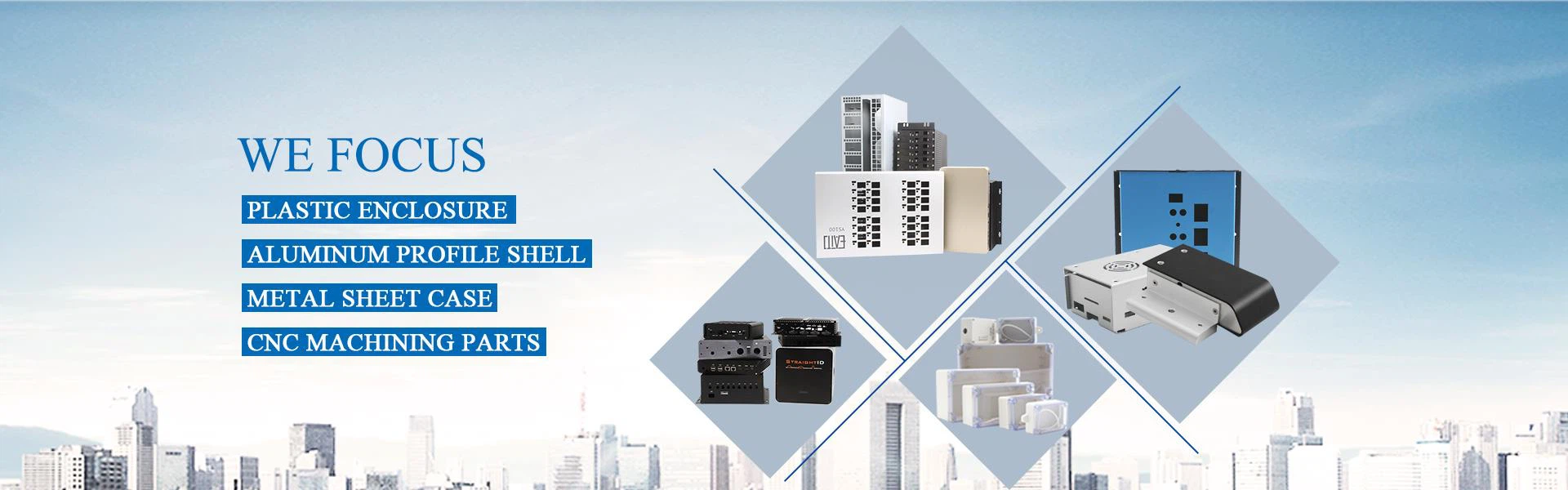
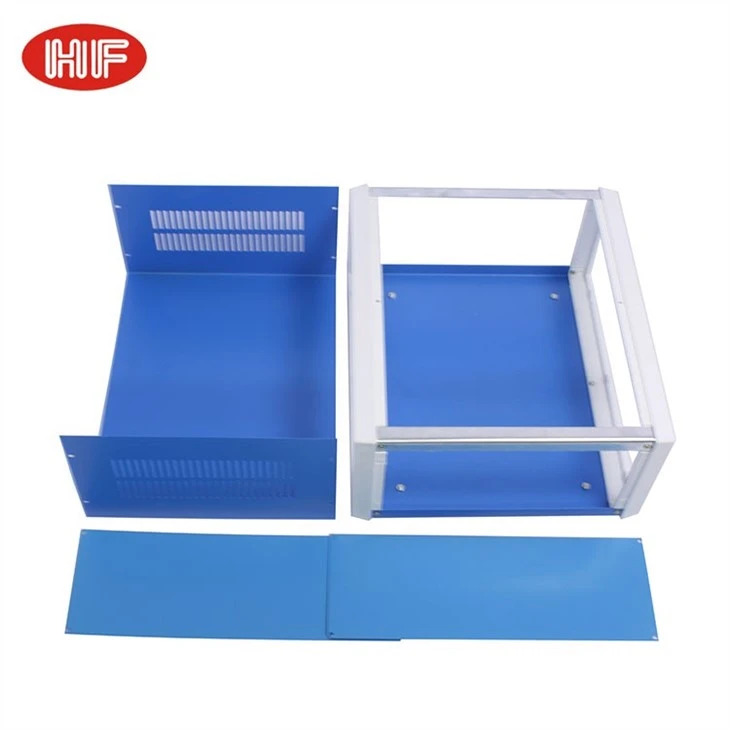
The sheet metal chassis is a chassis that is required for the use of a comprehensive cold working process for metal sheets (usually below 6 mm). Processing techniques include shearing, punching, cutting, compounding, folding, welding, riveting, splicing, forming.

Why choose us
01
Our Factory
Hongfa Shunda, located in Shenzhen, China, has a 5,000 square meter production facility that includes plastic injection production lines and CNC milling production lines.
02
Production Equipment
The company has several production lines and pieces of equipment, including injection machines, CNC machines, bending machines, laser cutting machines, and punching machines.
03
Production Market
Our products are sold all over the world, especially in North America, Western Europe, Asia, and Oceania.
04
Our Services
The company provides OEM/ODM custom services for electronic enclosures, including design, drawing, hole cutting, surface treatment, printing, and packing.
-
![Aluminum Raspberry PI 4 Case Enclosure]() Aluminum Raspberry PI 4 Case EnclosureRaspberry Pi is a single-board computer that was developed for educational purposes. It is a small-sized device that is capable of performing various tasks, from browsing the web to playing games...view more
Aluminum Raspberry PI 4 Case EnclosureRaspberry Pi is a single-board computer that was developed for educational purposes. It is a small-sized device that is capable of performing various tasks, from browsing the web to playing games...view more -
![Factory Suppliers Aluminum Extruded Electronic Housing Electronic Devices]() Factory Suppliers Aluminum Extruded Electronic Housing El...Customized rack mounted metal chassis for medical,electonic equipment and ect.view more
Factory Suppliers Aluminum Extruded Electronic Housing El...Customized rack mounted metal chassis for medical,electonic equipment and ect.view more -
![Aluminum Sheet Metal Enclosure Hongfa Case]() Aluminum Sheet Metal Enclosure Hongfa CaseQuick Details:view more
Aluminum Sheet Metal Enclosure Hongfa CaseQuick Details:view more
1. Model Number: HF-C-11
2. External Size: 80*215*190mm
3. Material: Aluminum alloy
4. Protection Level: IP54
5. Finish: Powder coating or... -
![Sheet Metal Enclosure Electronic Case]() Sheet Metal Enclosure Electronic CaseThis is a sheet metal enclosure,made of steel,the size,structure,color and material all can be customized as requestview more
Sheet Metal Enclosure Electronic CaseThis is a sheet metal enclosure,made of steel,the size,structure,color and material all can be customized as requestview more -
![Metal Case Battery Housing Steel Box]() Metal Case Battery Housing Steel BoxOur company mainly supply customization of electronic enclosures,the sheet metal case usually produce according to customers' design.but we also have standard samples,such as 1u,2u,3u,4u case.view more
Metal Case Battery Housing Steel BoxOur company mainly supply customization of electronic enclosures,the sheet metal case usually produce according to customers' design.but we also have standard samples,such as 1u,2u,3u,4u case.view more -
![Sheet metal Aluminium Enclosure Raspberry Pi 4 Case]() Sheet metal Aluminium Enclosure Raspberry Pi 4 CaseQuick Details:view more
Sheet metal Aluminium Enclosure Raspberry Pi 4 CaseQuick Details:view more
1. Model No.: Raspberry PI 4
2. External Size: 90*62.6*33.7mm
3. Material: aluminum alloy or steel
4. Finish: powder coating
5. Color: Black
6.... -
![Aluminum sheet case set top box]() Aluminum sheet case set top boxQuick Details:view more
Aluminum sheet case set top boxQuick Details:view more
1. Product: Sheet metal enclosure
2. Size: customized as required
3. Material: steel,SPCC,SECC,Aluminum,stainless steel etc.
4. Finish: Powder... -
![Sheet Metal Box Remote Controller Case]() Sheet Metal Box Remote Controller CaseMetal or steel boxes are more durable than plastic boxes and some, like gangable boxes, can be joined to add more devices. These boxes are used in garages and basements where they are likely to...view more
Sheet Metal Box Remote Controller CaseMetal or steel boxes are more durable than plastic boxes and some, like gangable boxes, can be joined to add more devices. These boxes are used in garages and basements where they are likely to...view more -
![Sheet Metal Case Aluminum Raspberry Steel Box]() Sheet Metal Case Aluminum Raspberry Steel BoxThis is a sheet metal case,mainly used for raspberry pi boards.view more
Sheet Metal Case Aluminum Raspberry Steel BoxThis is a sheet metal case,mainly used for raspberry pi boards.view more
Model No: Raspberry PI 4
External Size: 92*68*34mm
Material: Aluminum alloy 5052
Application: Raspberry PI... -
![Aluminum Enclosure Sheet Metal Rack Mount case]() Aluminum Enclosure Sheet Metal Rack Mount caseThis is desktop aluminum case,used for medical device,instrument control device etc.view more
Aluminum Enclosure Sheet Metal Rack Mount caseThis is desktop aluminum case,used for medical device,instrument control device etc.view more
Model No.:HF-C-16
External size: 200(H)*440(W)*400(L)mm
Material: Aluminum... -
![Aluminum Plastic Electrical Chassis Box]() Aluminum Plastic Electrical Chassis BoxThis is a Chassis box made of Iron & Plastic material. We are a factory have over 20 years experience in the product of electronic shell. We have excellent quality and competitive price.Hope we...view more
Aluminum Plastic Electrical Chassis BoxThis is a Chassis box made of Iron & Plastic material. We are a factory have over 20 years experience in the product of electronic shell. We have excellent quality and competitive price.Hope we...view more -
![Aluminum Case Plastic Frame Chassis Box]() Aluminum Case Plastic Frame Chassis BoxThis is a Desktop case made of Aluminum material. We are a factory have over 20 years experience in the product of electronic shell. We have excellent quality and competitive price.Hope we can...view more
Aluminum Case Plastic Frame Chassis BoxThis is a Desktop case made of Aluminum material. We are a factory have over 20 years experience in the product of electronic shell. We have excellent quality and competitive price.Hope we can...view more


What are the advantages of sheet metal chassis?
Lightweight: The sheet metal chassis is made of thin and light sheet metal materials, which is lighter and easier to carry and install than traditional cast iron or aluminum alloy chassis.
High strength: Although the sheet metal chassis is relatively thin and light, it is very strong. Through enhanced structural design and appropriate processing technology, sufficient strength and rigidity can be provided to protect the safety of internal equipment.
Good appearance: Sheet metal chassis are usually manufactured through precise molds and processing techniques, which can produce a flat, smooth, and consistent appearance. At the same time, the sheet metal chassis also has better design flexibility and can achieve more types of appearance.
Strong protective performance: Sheet metal chassis usually have good protective performance and can provide effective anti-seismic, dust-proof, waterproof, anti-corrosion and other functions to protect internal equipment from the external environment.
Easy to process and customize: Sheet metal materials have good plasticity and processability, and can be easily processed by cutting, stamping, bending and other processing techniques. This allows the sheet metal chassis to be customized and personalized according to specific needs to meet different user needs.
Good heat dissipation effect: Sheet metal material has good thermal conductivity, which can effectively dissipate heat and reduce internal temperature, improving the stability and working efficiency of the equipment.
Lower cost: Compared with chassis made of other materials, such as cast iron, aluminum alloy, etc., the manufacturing cost of sheet metal chassis is lower because the cost of the sheet metal material itself is relatively low and the processing and manufacturing processes are relatively simple.
The Production Process of Sheet Metal Chassis



Step 1: Design and Confirmation
First, based on customer requirements and the intended usage environment, detailed design drawings are created. These drawings include important parameters such as external dimensions, internal structure, and installation holes of the chassis. Our company typically calculates prices and processes products using DXF or STEP format drawings.
Step 2: Material Procurement
According to the design drawings, suitable materials are selected for procurement. Generally, the materials used to manufacture chassis include cold-rolled plates, stainless steel, and aluminum alloys.
Step 3: Plate Cutting
The purchased sheets are accurately cut according to the design drawings to ensure that the size and shape of each piece meet the requirements.
Step 4: Stamping and Forming
The cut sheet metal undergoes corresponding stamping processes, including bending, punching, and stretching. Each process requires strict control to ensure the accuracy of the final shapes.
Step 5: Welding and Assembly
After stamping and forming the sheet metal, the components are welded and assembled. Welding is a key process that ensures the strength and sealing of the chassis, requiring a high level of skill and experience.
Step 6: Painting and Coating
After production, the chassis undergoes painting and coating to improve its anti-corrosion and aesthetic properties. This step also tests the manufacturer's technical capabilities and quality management.
Step 7: Product Inspection
Throughout the manufacturing process, strict inspections are required for each step to ensure that all components meet design requirements and quality standards. After completing the chassis, a comprehensive inspection of the finished product is conducted.
Processing technology of sheet metal chassis
Blanking
According to the different processing methods, the cutting can be divided into general punching, number punching, shearing machine cutting, laser cutting, and wind cutting. Due to the different processing methods, the processing technology of the cutting is also different. Sheet metal blanking methods are mainly digital punching and laser cutting.
01
Bend
When the material is bent, the outer layer is stretched on the rounded area, and the inner layer is compressed. When the thickness of the material is fixed, the smaller the inner r, the more severe the material’s tensile and compression; when the tensile stress of the outer corner fillet exceeds the material’s ultimate strength, cracks and breaks will occur, therefore, the structure of the bent part Design should avoid too small bending radius.
02
Stretch
The radius of the fillet between the bottom of the tensile member and the straight wall should be greater than the plate thickness, ie r1≥t. In order to make the drawing progress more smoothly, generally take r1=(3~5)t, the maximum fillet radius should be less than or equal to 8 times the thickness of the plate, that is r1≤8t. Due to the different stresses on the stretched parts, the thickness of the material after stretching will change. Generally speaking, the center of the bottom maintains the original thickness, the material at the bottom fillet becomes thinner, the material at the top near the flange becomes thicker, and the material around the round corner of the rectangular stretch member becomes thicker.
03
Forming
Pressing ribs on the plate-shaped metal parts helps to increase the structural rigidity. The blinds are usually used for ventilation and heat dissipation on various enclosures or cabinets. The molding method is to cut the material by the edge of the punch. The remainder of the punch simultaneously stretch-deforms the material to form a undulating shape with one side open.
04
Welding
Welding methods mainly include arc welding, electroslag welding, gas welding, plasma arc welding, fusion welding, pressure welding and brazing. The welding of sheet metal products is mainly arc welding and gas welding.
05
Sheet Metal Chassis Material
Different uses of CNC chassis determine the design and the selection of material. For vehicles, the material used for the construction of the chassis is usually carbon steel, but it is also becoming more commonplace that they are made up of aluminum alloys considering its light-weight characteristic.
Materials for chassis CNC: SGCC galvanized plate, SECC electrolytic plate, SUS stainless steel (model 201 304 316, etc.), SPCC iron plate, white copper, red copper, AL aluminum plate (model 5052 6061, etc.), SPTE, spring steel, manganese steel.
How to Determine the Right Sheet Metal Thickness for a Sheet Metal Chassis?

Sheet Metal Gauges
When determining the appropriate width and thickness of sheet metal, sheet metal gauges can serve as a helpful guide. There is a clear inverse relationship between the gauge number and the actual sheet thickness; a higher gauge number corresponds to a thinner sheet. For example, 10-gauge steel sheets measure about 0.1345 inches in thickness, while 20-gauge steel sheets measure about 0.0320 inches. The selection of the gauge depends on your application’s desired balance between weight and structural strength. Additionally, it's important to consider manufacturing requirements, as bending and forming heavier gauges can be more challenging, which may lower production efficiency. Staying within accepted industry standards and specifications is essential to enhance performance capabilities and maintain economic viability.
Sheet Metal Thickness
To choose the right sheet metal thickness, we can summarize the insights from the top three sources as follows:
The Fabricator: Recommendations regarding fabrication designs are application-based, taking into account load-bearing needs, flexibility, and the environment in which the sheet metal will be used. It may be beneficial to use higher gauges for easier forming, but this should not compromise necessary strength.
Attention should be given to the interplay between performance parameters of the materials and their costs. The lowest viable gauge that is economically and easily manufactured can often be used in construction applications, provided that mechanical strength and durability requirements are met. Trade-offs frequently occur between material type and thickness, balancing performance with cost-effectiveness.
Metal Supermarkets: This source recognizes gauge selection as a practical issue and provides guidance on achieving it, including reference to industry standards. The processing method to be employed—whether cutting, forming, or welding—will determine the appropriate gauge, ensuring that the structure is not weakened.
In conclusion, by considering design features and manufacturing processes, you can select an appropriate sheet metal thickness.


Thickness of the Metal
To promptly select the correct thickness of sheet metal, we draw insights from the three best sources:
The Fabricator: Understanding application parameters is essential. If flexibility is limited, the key factors are load-bearing capacity, flexibility, and the environment where the product will be used. Higher gauges are preferred for applications requiring more flexibility and ease of forming, while sufficient strength must also be maintained.
This source warns about the tension between technology and economics. While thin gauges are generally cheaper and easier to produce, they must meet the application’s mechanical strength and durability requirements. Some sheet metal enclosures can be challenging to manufacture. Typically, an effective approach is to consider both the type of material and its thickness to balance economic and technical requirements.
Metal Supermarkets: Selecting the appropriate gauge involves common sense, including adherence to standards and evaluating the ease of cutting the material. During processing—such as cutting, forming, and welding—care must be taken to choose a gauge that optimizes structural properties without compromising integrity.
Our Factory
Shenzhen Hongfa Shunda Mould Co.,Ltd is a manufacturer of plastic and hardware molds and enclosures,located in Shenzhen China,and have more than 20 years industry experience.
Mainly engaged in the design, production and sales of electronic enclosures, providing one-stop enclosure solutions for electronic products.
Our main products include: plastic injection molds,plastic enclosures,aluminum extruded box,sheet metal enclosures,die casting aluminum case,waterproof junction box,CNC milled parts etc.


FAQ
We're professional sheet metal chassis manufacturers and suppliers in China, specialized in providing high quality custom service. We warmly welcome you to wholesale hot sale sheet metal chassis at competitive price from our factory.
1U Server Chassis, Metal Enclosures IP65, Steel Electrical Boxes NEMA Rated
