

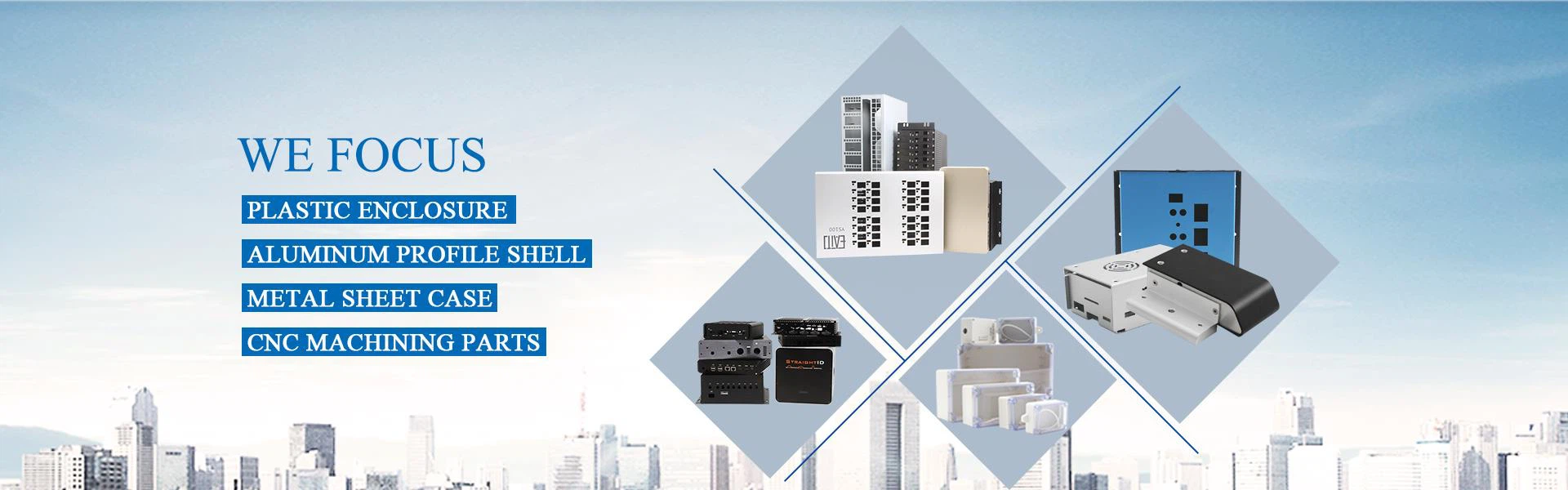
Aluminum die casting is a metal-forming process that allows for the creation of complex aluminum parts. Ingots of aluminum alloy are heated to very high temperatures until they are entirely molten.

Why choose us
01
Our Factory
Hongfa Shunda, located in Shenzhen, China, has a 5,000 square meter production facility that includes plastic injection production lines and CNC milling production lines.
02
Production Equipment
The company has several production lines and pieces of equipment, including injection machines, CNC machines, bending machines, laser cutting machines, and punching machines.
03
Production Market
Our products are sold all over the world, especially in North America, Western Europe, Asia, and Oceania.
04
Our Services
The company provides OEM/ODM custom services for electronic enclosures, including design, drawing, hole cutting, surface treatment, printing, and packing.
-
![Outdoor Waterproof Die Cast Aluminum Junction Box]() Outdoor Waterproof Die Cast Aluminum Junction BoxWaterproof Die Cast Aluminum Junction Boxes are electronic enclosures that are designed to keep electronic components protected from environmental factors like water, dust, dirt, and other debris....view more
Outdoor Waterproof Die Cast Aluminum Junction BoxWaterproof Die Cast Aluminum Junction Boxes are electronic enclosures that are designed to keep electronic components protected from environmental factors like water, dust, dirt, and other debris....view more -
![Deep Machining Aluminum Enclosure Electronic Controller Box]() Deep Machining Aluminum Enclosure Electronic Controller BoxMetal Enclosure Boxes for Electronics.Sturdy and rugged, metal enclosures provide excellent protection for your electronics in both indoor and outdoor environments.view more
Deep Machining Aluminum Enclosure Electronic Controller BoxMetal Enclosure Boxes for Electronics.Sturdy and rugged, metal enclosures provide excellent protection for your electronics in both indoor and outdoor environments.view more -
![Aluminium Die Casting With Powder Coating]() Aluminium Die Casting With Powder CoatingAluminium Die Casting With Powder Coating Product Descriptions: 115(L)*90(W)*72(H)mm Aluminium die casting case was made by ABS. We have hundreds of aluminium die casting case. They have different...view more
Aluminium Die Casting With Powder CoatingAluminium Die Casting With Powder Coating Product Descriptions: 115(L)*90(W)*72(H)mm Aluminium die casting case was made by ABS. We have hundreds of aluminium die casting case. They have different...view more


Advantages of Aluminum Die Casting
Lightweight and Strong: Aluminum is a lightweight and strong material that is highly valued in various industries. Aluminum die casting allows for the production of lightweight parts with high strength-to-weight ratios. This makes aluminum die casting an ideal choice for manufacturing parts that require both strength and weight savings.
High Precision: The die casting process produces highly accurate and precise parts with tight tolerances. This means that the parts produced through die casting require minimal or no post-processing, reducing the time and cost of production.
Excellent Surface Finish: Aluminum die casting produces parts with a smooth and uniform surface finish. This eliminates the need for additional surface finishing processes, such as sandblasting or painting, which can be time-consuming and costly.
Versatility: Aluminum die casting can produce parts of various shapes and sizes, making it a versatile manufacturing process. This allows manufacturers to create complex parts with intricate details that would be difficult or impossible to produce using other manufacturing processes.
Cost-Effective: Aluminum die casting is a cost-effective manufacturing process due to its high production efficiency, minimal post-processing requirements, and the ability to produce parts with high precision and accuracy. This makes aluminum die casting an attractive option for large-scale production runs.
Durability: Aluminum die casting produces parts that are highly durable and resistant to corrosion, making them ideal for use in harsh environments or applications where parts are subjected to high stress or wear.
Aluminum Die Casting Process
The aluminum die-casting process is both simple and efficient. The exact steps may vary with the type of injection method, but a general overview of the die-casting process is:
Pattern-making
Before manufacturing the actual part, the first step is to create a pattern or model. Models are often made from materials, such as metal, wax, plastic or wood, and can be made by 3D printing or computer numerical control (CNC) machining.
Molding
The next step is to design a die-casting mold. Typically made from steel via CNC machining, the mold will contain the molten metal until it hardens, so it must possess the necessary injection sites and have an exact negative of the model’s geometry. Die-casting molds are typically made into two halves so that the final product can be easily extracted, and most are reusable to allow for multiple pours.
Melting and Injection
Once the mold is prepared, the aluminum ore is heated until it becomes completely molten and is inserted into the mold. Gravity die casting is done by pouring the molten metal into the mold, but injection die casting employs high-pressure injection to force it into each cavity. Aluminum melts at approximately 1220°F (660°C).
Extraction
Once the molten metal has cooled, the two halves of the mold are separated to extract the finished part.
APPLICATIONS OF ALUMINUM DIE CASTING


As aluminum is weightless, robust, and resistant to corrosion, it is one of the best choices for creating durable and trustworthy system components. Rather than that, aluminum’s economic advantages and mechanical properties make it the ideal choice for various applications and industries.
AUTOMOTIVE INDUSTRY
In the automotive industry, Aluminum die casting is ideal to use due to its properties like durability and lightweight alternative to steel and iron. Moreover, its lightweight feature makes it an excellent choice for transportable applications.
RENEWABLE ENERGY
In some parts, aluminum die casting is used for power generation and distribution equipment in the renewable energy industry. The process of aluminum die casting is used.
AEROSPACE
In the aerospace industry, aircraft demand components that can offer up-to-the-mark performance. Aluminum die castings are excellent for aircraft as they are lightweight, highly durable, and affordable as they can withstand harsh operating and environmental conditions and have better fuel efficiency.
AGRICULTURE SECTOR
Aluminum die castings can be utilized in several machines like combine harvesters or tractors in the agricultural industry. It is the best for use in these demanding applications as it offers durability and reliability.
RECREATIONAL VEHICLE
The aluminum die casting process helps create many recreational equipment and vehicle parts in the recreational equipment industry. For instance, structural and functional components like axles, chassis, counter mounts, etc., and cosmetic components like hood ornaments.
MILITARY/DEFENSE
Die casting helps produce parts for law enforcement, commercial, and military pieces in the military/defense industry. For example, it is used in making Remington receivers, trigger guards, and many other parts for shotguns and rifles.
INDUSTRIAL EQUIPMENT
Aluminum die castings are also used for multiple components of equipment and systems in the industrial machinery & equipment industry. For instance, die-cast equipment components cover connecting rods, bearings, and pistons.
MEDICAL INDUSTRY
Die-cast aluminum parts can be seen used in various devices and systems used in the medical industry. From diagnostic and treatment equipment to beds and surgical instruments, such productions are integrated into almost everything.
CONSUMER PRODUCTS INDUSTRY
Aluminum die castings are used in the consumer products industry. The elements help ensure the final products are robust as well as lightweight.
How Does Aluminum Die Casting Works?
Like any typical die casting process, aluminum die casting also involves the pouring of liquid aluminum into a mold called dies and allowing it to solidify into the desired shape. The die casting dies are made of at least two halves to permit the removal of castings. The shape of the dies influences the very complex shapes and intricate features in the casting. This is more or less the crux of any casting technique.
1. Ingots of aluminum alloys are exposed to high temperatures until they melt;
2. The two die halves are cleaned and lubricated before clamping them together;
3. The mold for the cast is prepared using two steel dies machined into the desired shape and clamped together by a die casting press;
4. The molten aluminum is then injected into the cavity at high pressures, allowing it to solidify;
5. The process of transferring the molten metal into a chamber before injection depends upon whether a cold chamber or hot chamber die casting machine is used;
6. The cold chamber die casting machines are used for casting alloys with high melting points such as aluminum, magnesium, etc. Therefore, aluminum die casting is done using a cold chamber machine in which the molten metal is ladled into the casting instead of being pumped by hydraulic cylinders;
7. The hot casting is allowed to cool down and solidify. The molten metal fills the die cavity to take up the desired shape of the die design;
8. The two die halves are separated and the casting is ejected;
9. Finally, the excess material attached to the aluminum casting is trimmed via secondary operations such as sawing, cutting, etc.

What are the Limitations of Aluminum Die Casting?
Aluminum die casting has some limitations, including:
PART SIZE
Aluminum die casting is limited in the size of parts that can be produced. Large parts may require a different manufacturing process.
TOOLING COSTS
The cost of tooling can be high for aluminum die casting, particularly for complex parts.
SURFACE FINISH
The surface finish of aluminum die cast parts may require additional machining or finishing to achieve the desired result.
9 Aluminum Die Casting Design Considerations to Keep in Mind
This section gives you an introduction to some of the most common considerations when designing a product to be made using die casting.
Parting line
As you already know from our previous article, the die casting process involves a die that is usually divided into two halves (although it can be divided into more), one of them mobile and the other static, that come together to form the mold where the molten metal will be injected. The parting line of a die-cast component is the interface where the two halves of the die come together.
Shrinkage
Shrinkage is a very common and unavoidable phenomenon that happens in most castings, and aluminum is no exception. As the molten metal starts to cool down from melting temperature to room temperature, the cast will shrink towards its center.
Castings commonly shrink between 0.4-0.6% of their volume, which can help the product to be ejected from the external walls of the die. Unfortunately, it can also constrict around any internal protrusions on the mold, making ejection difficult under those circumstances. In these situations, you can make use of a draft to reduce shrinkage and facilitate easier removal of the cast.
Draft
In the context of die casting, a draft is a small taper or inclination that can be seen on the sides of the mold that allow for easy ejection. You might have seen this taper in other kinds of molds, such as baking pans for muffins and bread, where the sides have a slight angle instead of being completely vertical.
Wall Thickness
In order to ensure rapid production, reduce material waste, and create a successful product, wall thickness has to be carefully considered.
A wall design that is too thin could prevent an adequate flow of the molten metal, making the metal solidify before the mold is completely filled. Thin walls can also be susceptible to warping when post-mold machining forces are applied. Excessively thick walls, on the other hand, not only waste casting material, but they increase solidification times, potentially eliminating the fast production cycle advantage of high-pressure die casting.
Fillets and Radii
Fillets and radii are curved junctures between two surfaces that would otherwise create a sharp edge. The following image shows an example of a part that incorporates each of these features. The key difference is that fillets exist on the internal edges of the part while Radii are found on the external edges.
Bosses
Bosses are protruding features of cast products that are normally used as standoffs or mounting points. This video displays a good visual for what a boss is by showing a boss being added to a doorknob. Including bosses in your design can prevent the need for time-consuming boring operations as a secondary process.
Ribs
Ribs are small bridges of material that can be added between walls to increase their strength without adding too much metal. They also help molten metal to reach every part of the die by increasing the available flow pathways.
Undercuts
Undercuts are known in manufacturing as recessed surfaces that cannot be accessed with a straight tool. The nature of undercuts can prevent die separation and cast ejection after solidification as the die will be essentially “gripping” the cast product, which is why careful design is important.
Holes and Windows
Accounting for the holes and windows needed in a final die cast part during the design phase can significantly reduce the amount of post-molding machining required. Eliminating or minimizing drilling, milling, and other machining activities wherever possible by thoughtful mold design can drastically improve manufacturing times.
What Are the Most Commonly Used Aluminum Die Casting Alloys?
Some of the most used aluminum die-casting alloys include CC401, A360, A413, B390, 383, and A380. The most important consideration when selecting the proper alloy is your planned application. For instance, B390 provides high hardness and excellent wear resistance, at the same time, it also has the lowest ductility compared to the other cast alloys.
That is why it is typically used for applications like automotive engine blocks. On the other hand, A360 provides the best pressure tightness, corrosion resistance, and excellent fluidity once they are molten.
While Alloy A380 is the jack of all trades since it offers an excellent blend of casting and product properties. Additionally, it is also the most typically specified alloy for casting several products.
Our Factory
Shenzhen Hongfa Shunda Mould Co.,Ltd is a manufacturer of plastic and hardware molds and enclosures,located in Shenzhen China,and have more than 20 years industry experience.
Mainly engaged in the design, production and sales of electronic enclosures, providing one-stop enclosure solutions for electronic products.
Our main products include: plastic injection molds,plastic enclosures,aluminum extruded box,sheet metal enclosures,die casting aluminum case,waterproof junction box,CNC milled parts etc.


FAQ
We're professional aluminium die casting manufacturers and suppliers in China, specialized in providing high quality custom service. We warmly welcome you to wholesale hot sale aluminium die casting at competitive price from our factory.
aluminium die casting solenoid coil, aluminium die casting transformer, aluminium die casting jack
