

In the world of industrial design and manufacturing, sheet metal enclosures serve as the backbone for protecting electronic components, machinery, and sensitive equipment. Particularly when the design gets complicated-characterized by irregular shapes, tight tolerances, or multifunctional requirements-the challenge for design engineers intensifies. This blog explores the key design considerations for complex irregular sheet metal enclosures, offering insights from industry standards and expert publications to guide you toward optimized, innovative enclosure solutions.
---
### Understanding the Complexity of Irregular Sheet Metal Enclosures
Sheet metal enclosures are typically fabricated from materials like steel, aluminum, or stainless steel, formed through processes such as stamping, bending, welding, and finishing. While regular enclosures conform to standard rectangular or square shapes, *complex irregular sheet metal enclosures* deviate in shape due to specific mechanical, spatial, or aesthetic requirements.
Irregular enclosures are often demanded by industries such as aerospace, medical instrumentation, telecommunications, and automotive sectors where space constraints and multifunctionality are key. This irregularity may mean curved surfaces, varying wall thicknesses, multiple access points, or nested internal compartments-all of which add layers of design complexity.
---
### 1. Early Integration of Design for Manufacturability (DFM)
One of the most crucial factors in developing complex irregular sheet metal enclosures is **Design for Manufacturability (DFM)**. According to the seminal reference from *"Sheet Metal Design Handbook"* by Ron Fournier (2015), early-stage collaboration between design engineers and fabrication teams reduces costly iterations.
For example, when considering bends or folds in irregular shapes, designers must understand tooling constraints. Not all bends can be formed easily with standard press brakes or progressive dies, especially as radii and angles vary. Incorporating DFM principles ensures:
- Minimization of secondary operations (e.g., excessive welding or finishing)
- Feasible tool selection
- Efficient material utilization, reducing scrap rates
Thus, early DFM consideration not only enhances manufacturability but also shortens production lead times.
---
### 2. Material Selection: Balancing Strength, Weight, and Formability
Material choice deeply influences the final enclosure's function and appearance. Complex irregular designs often require materials with superior formability to accommodate bends, curves, and cutouts without cracking.
- **Aluminum alloys** stand out because of their excellent formability, lightweight nature, and corrosion resistance-essential for aerospace and medical equipment applications.
- **Stainless steel** offers strength and corrosion resistance but needs more precise control during forming due to work hardening effects.
- **Cold-rolled steel** provides cost-effectiveness and strength but may require protective coatings.

The *Machinery's Handbook* (31st Edition, 2000) points out that selecting the correct tempering state (e.g., soft vs annealed) impacts how the material behaves under complex forming sequences. Designers should collaborate with fabricators to specify material grades that match forming techniques such as hydroforming, stamping, or roll forming, which are often employed for irregular profiles.
---
### 3. Tolerance Control and Dimensional Accuracy
Complex irregular sheet metal enclosures, owing to their multifaceted geometries, demand stringent tolerance control. Unlike regular enclosures where uniform flatness and bend tolerances dominate, irregular enclosures involve the accumulation of variations across multiple axes and curves.
According to *ASME Y14.5-2018*-the widely recognized geometric dimensioning and tolerancing (GD&T) standard-applying proper datum references and control frames to curved and compound surfaces ensures that the part integrates seamlessly within assemblies.
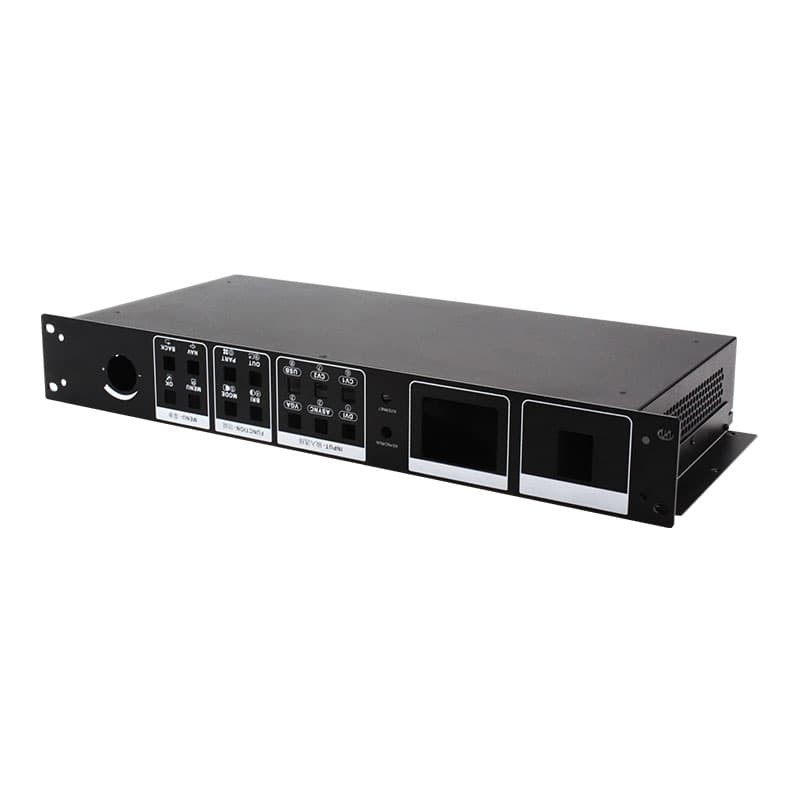
Laser scanning and digital inspection tools allow real-time verification of complex features. Implementing these advanced metrology techniques mitigates fitment issues in early prototype stages, ensuring:
- Proper alignment of mounting brackets
- Seamless integration with internal components
- Reliable sealing for environmental protection
---
### 4. Addressing Thermal Management in Sheet Metal Enclosures
Enclosures are often required to protect sensitive electronics, many of which generate heat during operation. For complex irregular sheet metal enclosures featuring enclosed volumes, ensuring adequate thermal management without compromising structural integrity is essential.
Design strategies include:
- Incorporating **ventilation slots**, louvers, or heat dissipation fins designed to not weaken structural support.
- Using **thermal break materials** or coatings applied internally to reduce heat transfer to sensitive components.
- Selecting materials with high thermal conductivity (such as aluminum alloys) to passively conduct heat away.
The book *"Thermal Design: Heat Sinks, Thermoelectrics, Heat Pipes, Compact Heat Exchangers, and Solar Cells"* by HoSung Lee (2013) highlights the need to integrate heat transfer simulations early in the design process to optimize airflow within complex enclosure geometries.
---
### 5. Ensuring Environmental Protection and Compliance
Irregular sheet metal enclosures often serve in challenging environments-from outdoor weather exposure to industrial chemical atmospheres. Achieving suitable **Ingress Protection (IP) ratings** is critical to product reliability.
Design guidelines from the IEC 60529 standard outline the necessity to:
- Include proper gasket seals at mating joints and access panels.
- Design overlapping flanges or labyrinth seals in irregular contours to prevent water ingress.
- Use corrosion-resistant finishes or coatings suitable for the intended environment, such as powder coatings, anodizing, or nickel plating.
Seam welding, resistance spot welding, or clinching methods may be applied to maintain enclosure integrity without compromising irregular shapes.
---
### 6. Designing for Assembly and Maintenance
Complex internal configurations arise in irregular sheet metal enclosures due to the need to house numerous internal components or modular systems. Designers must consider:
- Accessibility via removable panels or hinged doors, while maintaining enclosure rigidity.
- Standardizing fastener types and locations for ease of assembly.
- Integrating cable management features such as molded channels or snap-in clip locations.
As noted in *"Design for Assembly and Disassembly"* by Geoffrey Boothroyd (1994), facilitating ease of maintenance improves product lifecycle and customer satisfaction.
---
### 7. Leveraging Advanced Fabrication Technologies
Fabrication of irregular sheet metal enclosures benefits greatly from advances in manufacturing technology:
- **Laser cutting** enables precise and intricate cutouts with minimal thermal distortion.
- **Waterjet cutting** handles thicker gauges or exotic materials while maintaining edge integrity.
- **Hydroforming** or **incremental sheet forming** allows for creating complex three-dimensional shapes without expensive tooling.
- **3D CAD/CAM integration** and **finite element analysis (FEA)** software predict deformation and stress points, enabling iterative virtual refinement.
Manufacturers such as Protolabs emphasize these technologies in their white papers, showcasing faster turnaround times and cost efficiencies for complex designs.
---
### Conclusion
Designing complex irregular sheet metal enclosures is no trivial task; it requires a multi-disciplinary approach combining material science, manufacturing process knowledge, mechanical engineering, and environmental considerations. Early collaboration between design and fabrication teams, informed material selection, stringent tolerance control, effective thermal management, and leveraging state-of-the-art fabrication methods are keystones of success.
As industries demand increasingly sophisticated, customized enclosures, mastering these design considerations will empower engineers and manufacturers to deliver robust, innovative sheet metal enclosure solutions that meet both functional and aesthetic requirements.
---
### References
- Fournier, R. (2015). *Sheet Metal Design Handbook: Tips and Techniques for Manufacturing*. Industrial Press.
- Lee, H. (2013). *Thermal Design: Heat Sinks, Thermoelectrics, Heat Pipes, Compact Heat Exchangers, and Solar Cells*. Wiley.
- Boothroyd, G. (1994). *Design for Assembly and Disassembly*. Marcel Dekker.
- *Machinery's Handbook*, 31st Edition, 2000. Industrial Press.
- ASME Y14.5-2018: *Dimensioning and Tolerancing Standard*.
- IEC 60529: *Degrees of Protection Provided by Enclosures (IP Code)*.
- Protolabs White Papers. (n.d.). Sheet Metal Fabrication Technologies. https://www.protolabs.com/resources/white-papers/
---
If you're embarking on designing a complex irregular sheet metal enclosure, consider these guidelines as your roadmap for successful product realization. Staying current with technological advancements and industry standards will place you ahead in creating high-quality, cost-effective enclosures that perform reliably in the real world.

