

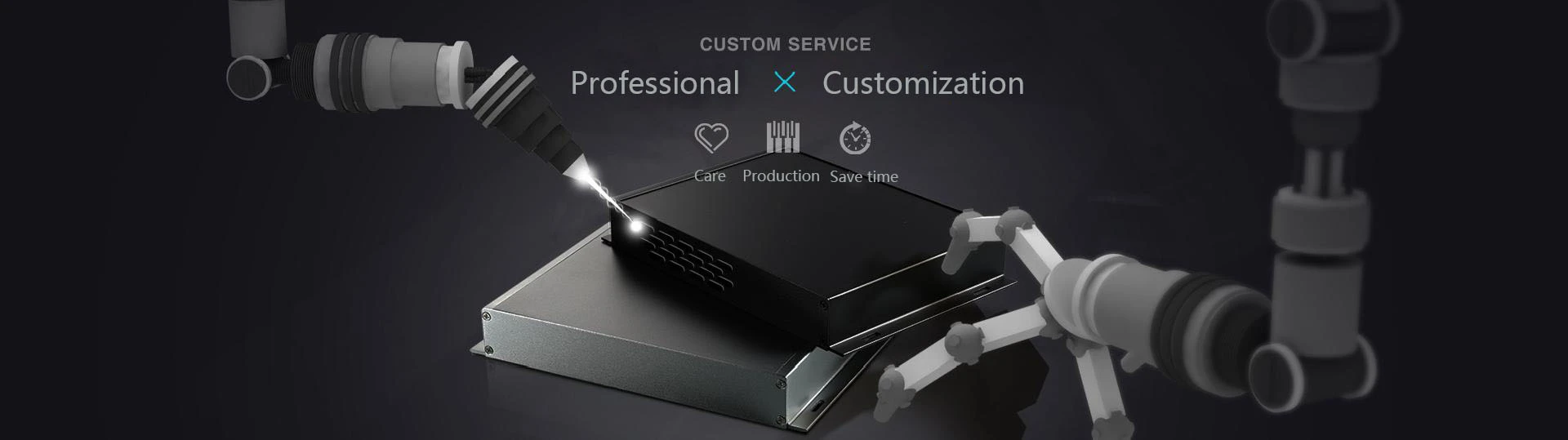
 In the fast-paced world of electronics manufacturing, aluminum extrusion boxes have become the go-to choice for protecting sensitive components inside electronic devices. These lightweight, thermally conductive electronic enclosures offer excellent EMI shielding, corrosion resistance, and the ability to integrate fins or mounting rails directly into the profile. Yet one persistent challenge continues to frustrate engineers and production teams: deformation during extrusion and subsequent processing. Warping, twisting, bowing, or waviness can ruin dimensional tolerances, compromise assembly fit, and turn a precision aluminum box into scrap.
Deformation is not a superficial cosmetic issue-it directly impacts the reliability of electronic enclosures used in everything from power supplies and 5G base stations to medical diagnostic equipment and industrial controllers. When a thin-walled aluminum extrusion box warps by even 0.5 mm over a 500 mm length, PCBs may not seat properly, gaskets lose compression, and heat sinks lose contact efficiency. Industry data from custom enclosure manufacturers show that unresolved distortion can push reject rates above 15 % and add weeks to tooling iteration cycles. Fortunately, a combination of proven metallurgical practices, process controls, and simulation tools can eliminate most deformation problems. This article presents six practical, field-tested solutions grounded in professional literature and real-world extrusion standards.

Understanding the Root Causes of Deformation
Deformation in aluminum extrusion arises from three primary mechanisms: unbalanced metal flow, thermal gradients during cooling, and residual stresses introduced during post-processing. As the billet is forced through the die, friction and varying bearing lengths create velocity differences across the profile cross-section. Thin walls in electronic enclosure designs exacerbate this because they cool faster than thicker sections, generating internal stresses that manifest as bowing or twisting once the profile exits the press.
Non-uniform quenching intensifies the problem. Rapid cooling to achieve T5 or T6 temper locks in residual stresses, particularly in asymmetrical or thin-walled profiles common to aluminum boxes for electronic devices. Subsequent stretching, machining, or even transport vibration can release or redistribute these stresses, producing permanent distortion. The Aluminium Extrusion Manual (Australian Aluminium Council, 2023) explicitly notes: "Some shapes tend to invite distortion during the extrusion process-such as an asymmetric profile or thin details at the end of a long flange." Similarly, Pradip K. Saha's Aluminum Extrusion Technology (ASM International, 2000) devotes entire sections to how improper die bearing design and unstable press operation amplify these effects.
In the context of electronic enclosure production, where wall thicknesses often drop below 2 mm to save weight and improve thermal performance, these issues become critical. A 6063-T6 aluminum extrusion box that bows 1 mm over its length may fail IP65 sealing tests or create hot spots in power electronics.
Solution 1: Optimize Die Design and Bearing Length Configuration
The single most effective way to prevent deformation is balanced metal flow through precision die design. By adjusting bearing (land) lengths-shortening them in thick sections and lengthening them in thin or distant areas-extruders achieve uniform exit velocity. HTS Aluminum's technical guide on extrusion defects states that "improper die bearing design" is the leading cause of waviness, bending, and plane-gap deformation, recommending iterative bearing corrections until flow velocity differences fall below 5 %.
For electronic enclosure profiles with internal ribs or asymmetric heat-sink fins, advanced die features such as porthole optimization and corner radii (minimum 0.5 mm) further reduce stress concentrations. The Australian Aluminium Council manual advises keeping adjacent wall-thickness ratios below 2:1 and using generous fillets at thickness transitions. Many custom enclosure shops now employ 3D-printed die prototypes or EDM machining to achieve first-run success rates above 90 %. When applied correctly, these die refinements alone can reduce longitudinal bow in a typical 6061 aluminum box from 2 mm/m to under 0.3 mm/m.
Solution 2: Tight Control of Extrusion Temperature and Ram Speed
Temperature and speed are the "thermodynamic levers" of deformation control. Extruding at 480–520 °C with ram speeds of 5–15 m/min (depending on alloy) minimizes adiabatic heating while maintaining flow stability. Excessive speed creates surface tearing and internal heat gradients; too slow allows partial recrystallization and grain growth that lock in stresses. Saha (2000) emphasizes isothermal extrusion techniques-maintaining container and billet temperatures within ±5 °C-to reduce distortion variance.
In practice, modern presses with closed-loop PLC control and infrared pyrometers at the die exit can hold profile temperature within 10 °C. For electronic device aluminum boxes requiring tight tolerances (±0.1 mm), lowering ram speed by 20 % during the final 30 % of the billet often eliminates the classic "leading-end bend" caused by external resistance at the run-out table. Combined with graphite guiding plates or shaped support tools immediately after the die, this technique keeps the profile straight until quenching begins.


Solution 3: Uniform Cooling and Quenching Strategies
Uneven cooling is the primary source of residual stress. Water spray or mist quenching must be symmetrical; air cooling alone is insufficient for heat-treatable alloys used in high-performance electronic enclosures. The key is to achieve a cooling rate of 50–100 °C/min across the entire cross-section. Langhe Industry's extrusion overview notes that "as the extruded profile cools, uneven contraction (especially in long or asymmetrical cross sections) can cause bowing or twisting," and recommends stretching within minutes of quench while the material is still plastic.
Advanced solutions include multi-zone spray systems with adjustable nozzles and infrared monitoring to equalize surface temperatures. For complex aluminum extrusion boxes with internal chambers, some manufacturers insert temporary mandrels or use pressurized air inside hollow sections during cooling. These methods, validated in T. Sheppard's Extrusion of Aluminium Alloys (Kluwer Academic Publishers, 1999), reduce residual stress by up to 70 % and limit post-cooling twist to <0.5°/m.
Solution 4: Controlled Post-Extrusion Stretching and Mechanical Straightening
Stretching remains the industry-standard correction for residual bow and twist. Applying 1–3 % elongation (typically 4–5 % for severe cases) with hydraulic pullers immediately after quenching plasticizes the profile and relieves internal stresses. Saha (2000, Chapter 6) details how proper stretching ratios, combined with spacer inserts in open sections, prevent secondary deformation during gripping. For thicker electronic enclosure walls that cannot tolerate high stretch ratios, roller leveling or hydraulic press straightening provides an alternative.
Critical caveat: over-stretching beyond 5 % can introduce new tensile stresses that cause cracking during later anodizing or CNC machining. Automated vision systems now measure straightness in real time and adjust stretch parameters dynamically, achieving dimensional compliance in >98 % of aluminum box runs.
Solution 5: Finite Element Analysis (FEA) for Predictive Profile and Process Design
Modern extrusion houses no longer rely on trial-and-error. Thermo-mechanical FEA simulates metal flow, temperature distribution, and stress evolution before the first billet is loaded. Research published on ResearchGate and ScienceDirect (e.g., studies on non-uniform cooling distortion) demonstrates that virtual die correction can predict and eliminate 80–90 % of bowing before physical tooling. By modeling bearing lengths, quench rates, and stretch percentages, engineers optimize aluminum extrusion box designs for electronic applications in days rather than weeks.
For electronic device enclosures with integrated heat sinks or card guides, FEA also predicts post-machining warpage caused by heat from CNC operations. Generous coolant flow and trochoidal milling paths-recommended in precision machining literature-further minimize this secondary distortion.
Solution 6: Strategic Alloy Selection, Heat Treatment, and Design-for-Manufacturability
Not all alloys behave the same. 6063-T5 offers superior extrudability and surface finish for cosmetic electronic enclosures, while 6061-T6 provides higher strength for structural aluminum boxes under vibration. The Australian manual and Langhe Industry both highlight 6101 for electrical conductivity in bus-bar-style enclosures. Designers should maintain minimum wall thicknesses of 1.5–2.0 mm, symmetrical cross-sections relative to the circumscribing circle, and avoid knife-edge features that invite distortion.
Post-extrusion artificial aging (T6) must follow precise time-temperature curves to stabilize grain structure without reintroducing quench stresses. When these metallurgical choices align with the first five solutions, deformation in aluminum extrusion boxes for electronic devices becomes a manageable engineering parameter rather than a production crisis.
Implementing a Deformation-Free Workflow
The most successful custom enclosure manufacturers integrate all six solutions into a single process map: FEA-driven die design → real-time temperature/speed control → symmetric quenching → immediate stretching → statistical process control (SPC) monitoring → final CNC with flood coolant. This holistic approach, supported by standards from ASM International and the Aluminum Extruders Council, routinely delivers electronic enclosures with straightness
Conclusion
Deformation in the processing of aluminum extrusion boxes for electronic devices is a solvable engineering challenge, not an inevitable cost of doing business. By addressing root causes through optimized die design, precise process parameters, uniform cooling, controlled stretching, predictive simulation, and smart material selection, manufacturers can consistently produce distortion-free aluminum boxes that meet the stringent tolerances demanded by today's high-performance electronics. The result is fewer rejects, faster time-to-market, and more reliable electronic enclosures that protect and cool sensitive components for years.

References
- Australian Aluminium Council. (2023). Aluminium Extrusion Manual. https://aluminium.org.au
- HTS Aluminum. (n.d.). Aluminum Extrusion Defects and How They Are Prevented. https://hts-alu.com/aluminum-extrusion-defects-and-how-they-are-prevented/
- Langhe Industry. (n.d.). Aluminum Extrusion: Techniques, Alloys, and Applications. https://langhe-industry.com/aluminum-extrusion/
- Saha, P.K. (2000). Aluminum Extrusion Technology. ASM International.
- Sheppard, T. (1999). Extrusion of Aluminium Alloys. Kluwer Academic Publishers.

